A lead magnet is something useful you give away in exchange for an email address: a checklist, a template, a short course, a calculator. Done well, it brings in people who are likely to become clients. Done badly, it fills your list with people who wanted a freebie and nothing else.
Here is how to build a lead magnet funnel that attracts the right people.
Step 1: Choose a lead magnet your future clients want
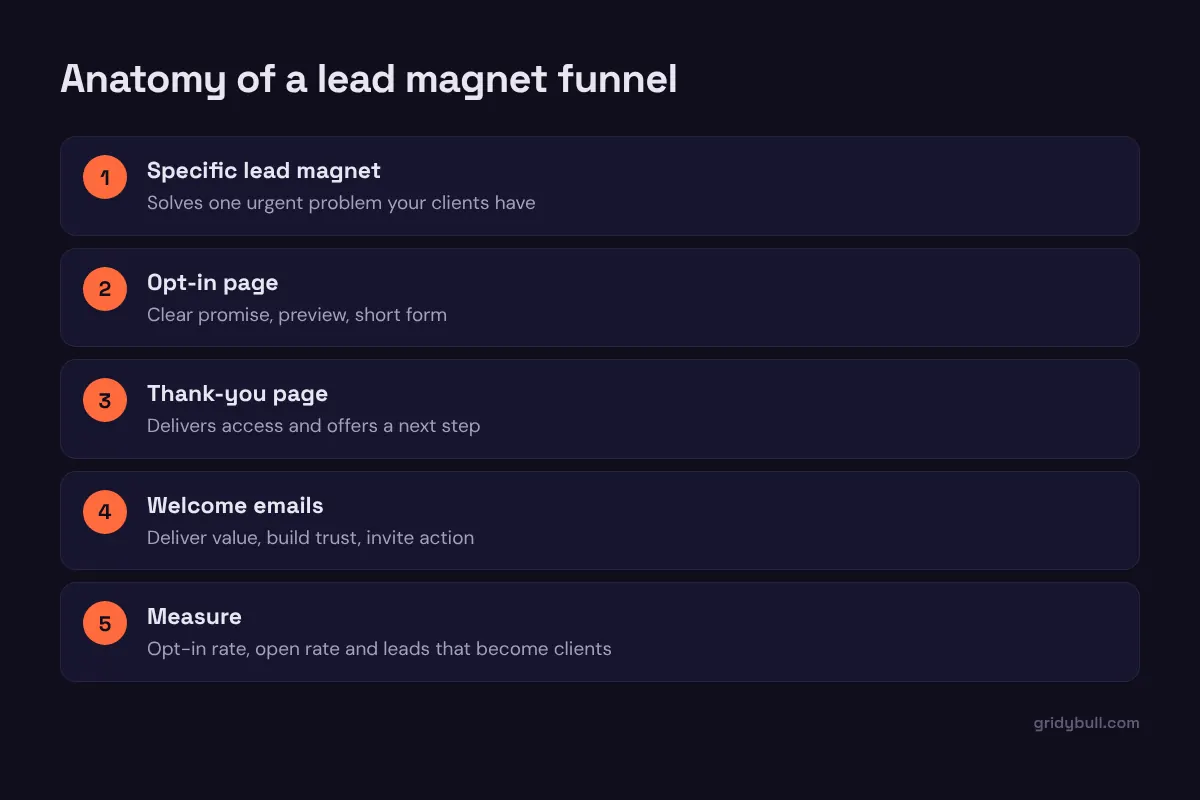
The best lead magnets solve one specific, urgent problem for the kind of client you want, and naturally lead toward what you sell. Good questions to ask:
- What do prospects ask on almost every sales call?
- What mistake do they make before they come to you?
- What quick win could they get in under an hour?
A “Shopify product page checklist” attracts store owners who might hire a Shopify developer. A generic “50 marketing tips” ebook attracts almost anyone.
Step 2: Pick a format people will actually use
Short and practical usually beats long and comprehensive. Formats that work well:
- Checklists and templates people can use immediately
- Swipe files and examples
- Short video trainings of 10 to 20 minutes
- Calculators and self-assessments
Step 3: Build a focused opt-in page
The opt-in page has one job: get the right people to request the lead magnet. Include:
- A headline that states the specific result
- Three to five bullet points on what is inside
- A preview image or mockup of the resource
- A short form, usually just first name and email
- A note on what happens next and how you use their email
Remove navigation and unrelated links so the page stays focused.
Step 4: Use the thank-you page wisely
The thank-you page is one of the most underused pages in any funnel. Right after opting in, people are paying attention. Use it to:
- Deliver the resource, or tell them exactly where to find it
- Introduce yourself briefly
- Offer a relevant next step, such as booking a call or watching a short video
Step 5: Write a welcome sequence
A short series of emails over the first week or two turns a download into a relationship. A simple structure:
- Delivery: the resource and a tip on how to use it.
- Quick win: one practical idea that builds on the lead magnet.
- Story or case study: how someone like them solved a bigger version of the problem.
- Objections: answer the questions that stop people from hiring help.
- Invitation: a clear, low-pressure invitation to the next step.
Step 6: Measure the right things
- Opt-in rate: how many page visitors request the lead magnet.
- Email engagement: opens and clicks on the welcome sequence.
- Lead-to-client rate: how many subscribers eventually book a call or buy.
The last number matters most. A lead magnet with a lower opt-in rate but more clients at the end is the better lead magnet.
Privacy and consent
Be clear about how you will use people’s email addresses, include an unsubscribe link in every email, and follow the privacy rules that apply to your audience’s location. Trust lost here is hard to win back.
A focused lead magnet, a clean opt-in page and a helpful welcome sequence can quietly bring in new leads every week, long after you set them up.
Related reading: What Is a Sales Funnel? A Plain-English Guide for Service Businesses